

How Artificial Intelligence Is Reshaping the Global Economic Outlook
Artificial intelligence is no longer affecting only technology companies. Investment in AI infrastructure, data centres, software, semiconductors and automation is beginning to influence economic growth, international trade, manufacturing activity and workforce planning.
Recent analysis from S&P Global Market Intelligence indicates that AI is becoming a measurable economic force—although its impact varies considerably across regions.
The United States is benefiting from rising technology investment, several Asia-Pacific economies are gaining from demand for AI hardware, and Europe is experiencing a more limited investment boost. At the same time, uncertainty remains around productivity, employment, supply-chain capacity and the return businesses receive from their AI projects.
AI Is Becoming a Macroeconomic Factor
AI was previously discussed mainly as a tool for automation, software development and digital transformation. It is now becoming relevant to broader economic indicators.
Investment in AI can influence:
- Business expenditure
- Manufacturing output
- Semiconductor demand
- International exports
- Data-centre construction
- Energy consumption
- Employee productivity
- Employment planning
- Financial markets
- Inflation and interest-rate decisions
This means economists and policymakers increasingly need to consider AI when evaluating economic growth and productivity.
However, AI’s economic impact is not straightforward. Infrastructure spending can boost economic activity before productivity improvements are visible, while rising technology exports may reflect higher prices rather than stronger shipment volumes.
AI Investment Is Supporting the US Economy
The United States has experienced one of the clearest economic effects from the AI investment cycle.
Spending on data centres, computers, software and research and development accelerated from early 2025. This helped support business investment while expenditure in some other non-residential categories weakened.
The AI boom has also influenced financial markets. A significant portion of recent US equity-market growth has been concentrated among large companies connected to artificial intelligence and its supporting infrastructure.
Higher market valuations can increase household wealth and support consumer spending. However, this also means parts of the economy may become more sensitive to corrections in AI-related company valuations.
AI Is Driving Manufacturing Growth
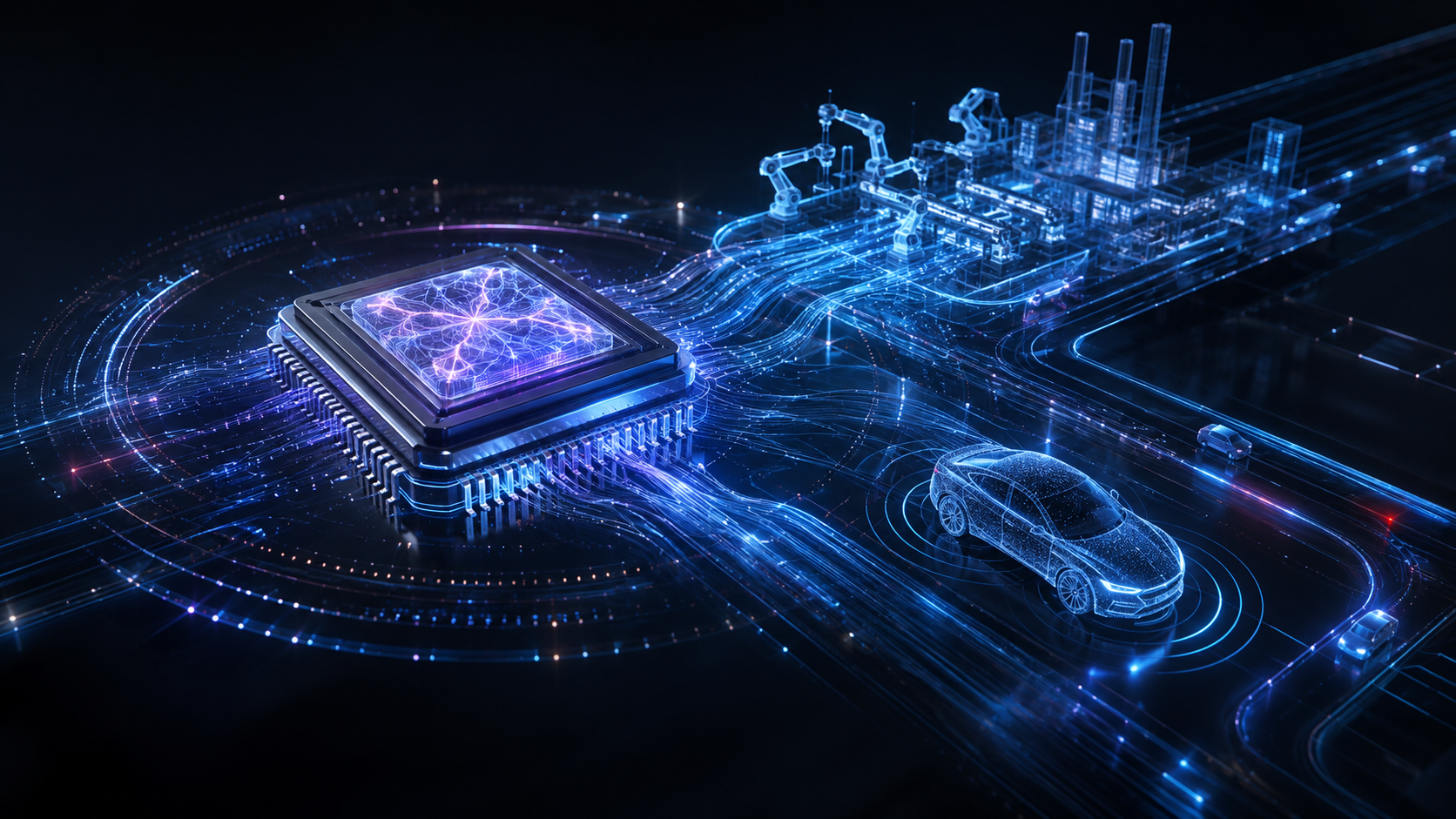
AI demand is moving beyond software and into physical infrastructure.
Modern AI systems require:
- Advanced semiconductors
- Servers and storage systems
- Networking equipment
- Data centres
- Cooling infrastructure
- Reliable electricity supplies
- Specialized manufacturing equipment
Economies central to AI development—including the United States, mainland China, Japan, Taiwan, South Korea and the Netherlands—have recorded stronger manufacturing growth than the broader global benchmark since late 2025.
Technology equipment has been among the strongest-performing manufacturing categories as companies invest in the hardware required to train, deploy and operate AI systems.
This demonstrates that the AI economy depends on an extensive industrial supply chain, not only on developers and software platforms.
Asia-Pacific Economies Are Benefiting From AI Exports
The effect of AI is particularly visible in Asia-Pacific trade and manufacturing.
Economies with established positions in semiconductor, server, storage and electronics supply chains are benefiting from rising demand for AI infrastructure.
Mainland China and several other regional economies have received economic support from exports of AI-related and adjacent technologies. This export demand has helped offset weaker domestic conditions in some markets.
Taiwan has benefited from its major role in global semiconductor production. South Korea, Japan and other manufacturing economies are also positioned within important parts of the technology supply chain.
The Netherlands, although outside Asia, has benefited through its role in advanced semiconductor equipment and related inputs.
Export Growth May Not Tell the Complete Story
Although AI-related exports are supporting economic activity, the quality of that growth requires careful analysis.
Part of the recent increase in semiconductor export values may be attributable to rising prices rather than an equivalent increase in physical shipment volumes.
Additional challenges include:
- Shortages of critical components
- Higher freight expenses
- Rising insurance costs
- Longer supplier delivery times
- Limited data-centre capacity
- Growing electricity requirements
- Dependence on specialized equipment
These constraints could raise the cost of AI deployment and reduce the durability of the current export cycle.
Countries heavily dependent on AI-related exports could also face slower growth if global technology demand weakens.
Europe Has Experienced a Smaller AI Investment Boost
Europe has not yet received the same economic benefit from AI investment as the United States.
Several factors may be restricting broader investment:
- Economic uncertainty
- Lower venture-capital funding
- High energy prices
- Expensive infrastructure development
- Differences in access to computing capacity
- Uneven adoption across companies
AI infrastructure requires substantial capital and electricity. Consequently, financing conditions and energy availability can significantly affect where companies build data centres and deploy large-scale AI systems.
AI could still improve Europe’s medium-term economic outlook if investment conditions strengthen and adoption expands. Its eventual impact will probably vary across industries and countries.
AI Could Influence Inflation and Interest Rates
AI’s implications for monetary policy remain uncertain.
If AI produces large productivity improvements, businesses may be able to increase output without creating equivalent cost pressures. This could expand the economy’s supply capacity and potentially reduce some inflationary pressure.
However, reaching that outcome may require significant spending on:
- Computing infrastructure
- Data centres
- Energy capacity
- Software
- Employee training
- Organisational transformation
Heavy investment could support demand and increase the economy’s neutral interest rate before the anticipated productivity benefits fully appear.
AI therefore does not automatically justify higher or lower interest rates. Policymakers must evaluate how quickly investment converts into real productivity gains.
Businesses Are Prioritising Productivity Over Job Cuts
Employment remains one of the most closely watched aspects of AI adoption.
S&P Global’s research found that enterprise AI initiatives are currently more focused on operational improvement than workforce reduction:
- 64% of surveyed enterprises identified process efficiency as an AI objective
- 59% cited employee productivity
- 24% identified head-count reduction
These findings suggest many companies initially view AI as a way to improve how employees work rather than simply eliminate positions.
Nevertheless, the effect will not be equal across occupations. Routine, repetitive and highly structured activities are more exposed to automation, while demand may increase for professionals who can build, manage, evaluate and govern AI systems.
Full Automation Is Not Yet the Main Objective
Across 38 AI use cases examined by S&P Global, average current adoption was reported at 50%, with an additional 37% planned over the following year.
However, only 22% of AI projects targeted a fully autonomous outcome.
This indicates that many businesses are pursuing human-AI collaboration instead of complete automation. Employees may continue making important decisions while AI handles research, analysis, content preparation, forecasting or repetitive processing.
The more immediate change may therefore be the redesign of tasks within existing roles rather than the disappearance of entire occupations.
What This Means for Technology Professionals
The expanding economic role of AI is likely to increase demand for professionals who can connect technology with business and industry requirements.
Relevant areas include:
- Artificial intelligence and machine learning
- Generative AI development
- Data engineering
- Cloud computing
- MLOps and LLMOps
- Cybersecurity
- Data-centre infrastructure
- Semiconductor technology
- Intelligent automation
- AI testing and validation
- Responsible AI and governance
- Business analysis
- Product management
- Supply-chain analytics
Technical knowledge alone may not always be sufficient. Professionals who understand finance, manufacturing, healthcare, automotive, retail or another industry can help organisations identify practical and valuable AI applications.
The myTectra Perspective
AI is moving from isolated experiments into the foundations of the global economy.
Its influence is already visible in data-centre construction, semiconductor manufacturing, technology exports, software investment and business-process redesign. However, the long-term outcome will depend on whether companies can convert infrastructure spending into measurable productivity.
For professionals, this shift strengthens the case for continuous learning. AI literacy is becoming relevant beyond data science and software engineering. Business analysts, managers, cybersecurity specialists, cloud professionals and industry experts increasingly need to understand how AI systems work and how their outputs should be evaluated.
The strongest career opportunities may emerge for people who combine practical AI capabilities with domain expertise and sound decision-making.
Final Thoughts
Artificial intelligence is beginning to reshape the global economic outlook through investment, manufacturing, trade and workforce transformation.
The United States is receiving a significant boost from AI-related capital expenditure, while Asia-Pacific economies are benefiting from demand for semiconductors, servers and other technology products. Europe’s investment response has been more limited, partly because of economic, funding and energy constraints.
Important uncertainties remain. Productivity gains may take time, supply-chain bottlenecks could slow deployment, and not every AI project will deliver an immediate return.
AI’s economic impact will ultimately depend on how effectively businesses, governments and professionals turn technological capability into sustainable productivity and broader value.


AI Jobs Are Growing Faster Than Ever: What It Means for Your Career in 2026
TCS and Porsche Partner to Accelerate AI-Powered Mobility
No Comments Yet
Let us know what you think